
By Shana Christrup, Senior Director Policy, AAM
In February 2026, the FDA announced labeling changes to clarify the risk of hormone replacement therapy (HRT). Namely, the FDA noted that the “black box warning” should be removed. The FDA initiated the removal of these warnings in November 2025, following a comprehensive review of the scientific literature. The FDA’s labeled recommendation is to start HRT within 10 years of menopause onset or before 60 years of age for systemic HRT.
Who currently produces estrogen patches?
There are currently six manufacturers of estrogen patches – Amneal, Bayer, Mylan/Viatris, Noven, Sandoz, and Zydus. In a recent FDA announcement related to estrogen patches, the FDA noted that it is working with all of these manufacturers to increase supply.
There are four different reference listed drugs (RLDs) within the Orange Book for estrogen extended-release films or estrogen systems.
Each patch is a sophisticated, multilayer system that combines the active pharmaceutical ingredient, adhesives, protective backing materials and other components. These elements work together to ensure safe and effective delivery of the medicine.
Are all estrogen patches the same?
No. As detailed above, as part of the FDA approval process, a generic drug product is one that is comparable to a brand drug product in dosage form, strength, route of administration, quality, performance characteristics, and intended use. A generic product for one RLD may not be the same as a generic product for another RLD, given that there are variations among RLDs.
However, depending on how your prescription is written and how your insurance covers various estrogen patches, there may be flexibility at the pharmacy counter about what may be dispensed.
How have generic manufacturers increased supply of estrogen patches?
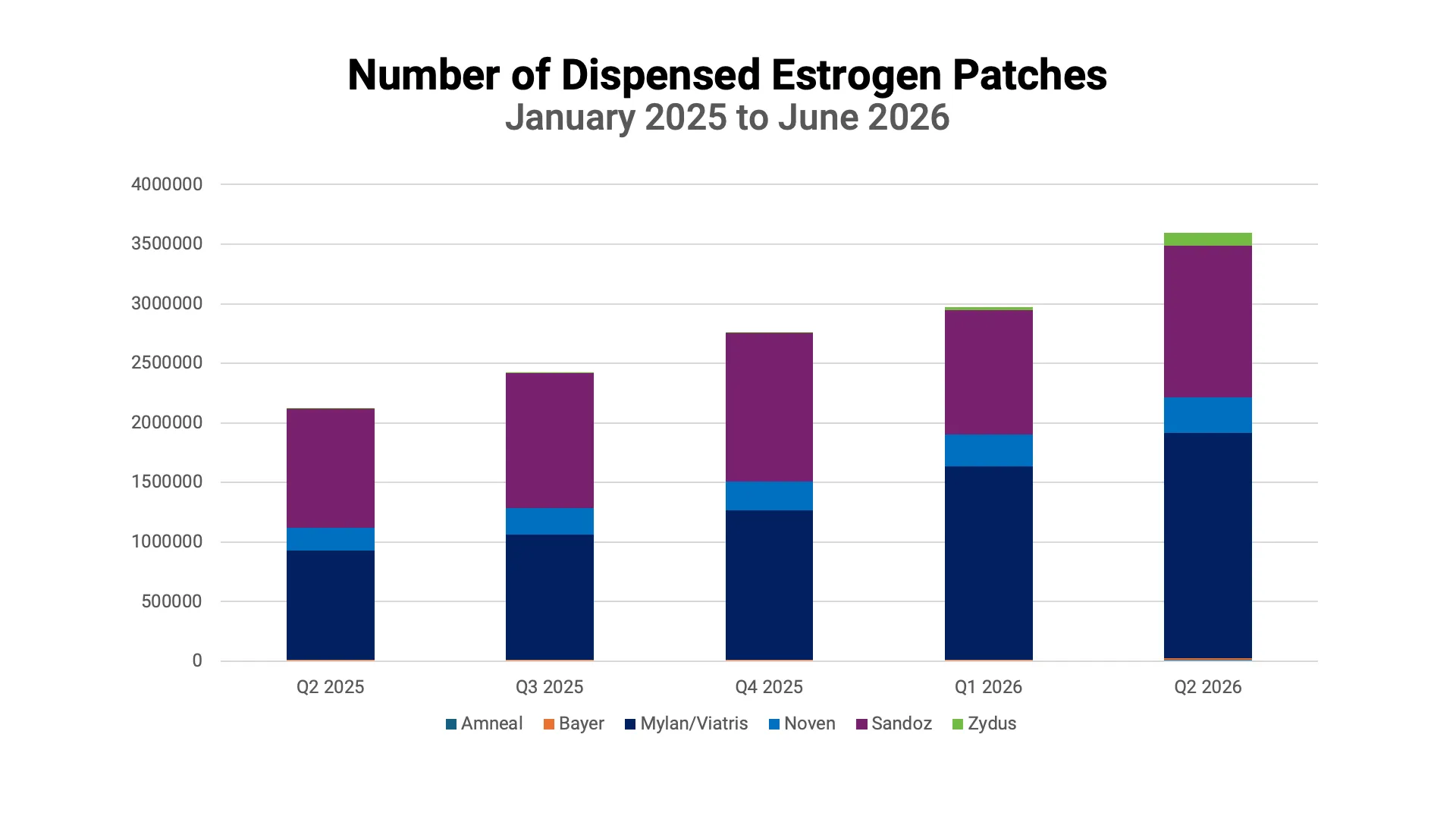
As alluded to in the aforementioned FDA announcement on estrogen patches, manufacturers of estrogen patches have dramatically increased supply of these products, as detailed in the graph below.1 According to an AAM analysis of IQVIA data, in a year in a half (from January 2025 to June 2026), the number of prescriptions for dispensed estrogen patches has doubled – from 1.8 M prescriptions to 3.6 M prescriptions. A large majority of that increase was met by AAM member companies – Amneal, Sandoz, and Zydus. Generic manufacturer Mylan/Viatris has increased supply as well.
Is there a shortage? Why isn’t the FDA declaring a shortage?
There are two main organizations that provide information on drug shortages – the FDA and ASHP. In general, ASHP is more likely to track regional drug shortages, while the FDA focuses more on shortages that are national in nature.
ASHP notes that there are a variety of regional shortages with respect to estrogen patches, including products manufactured by Amneal, Mylan/Viatris, Noven, Sandoz, and Zydus. ASHP further notes that the manufacturers are taking measures to address the situation, including weekly releases or allocation (i.e., limiting how much of a product each entity can receive).
Further, the FDA notes that the agency has taken steps to increase the supply of estrogen patches. While, under normal circumstances, declaring a drug shortage would allow compounding entities to produce the products in shortage, compounding entities are unlikely to have the technical expertise to produce the complex transdermal system required by estrogen patches. Those entities can and do provide other topical formulations of estrogen.
Reference
- Note: Amneal data from estradiol (which could include more than just estrogen patches). Bayer data from Climara (not Climara Pro).